
Mäkelä brings energy, urgency to Beethoven’s Missa Solemnis in Orchestre de Paris concert

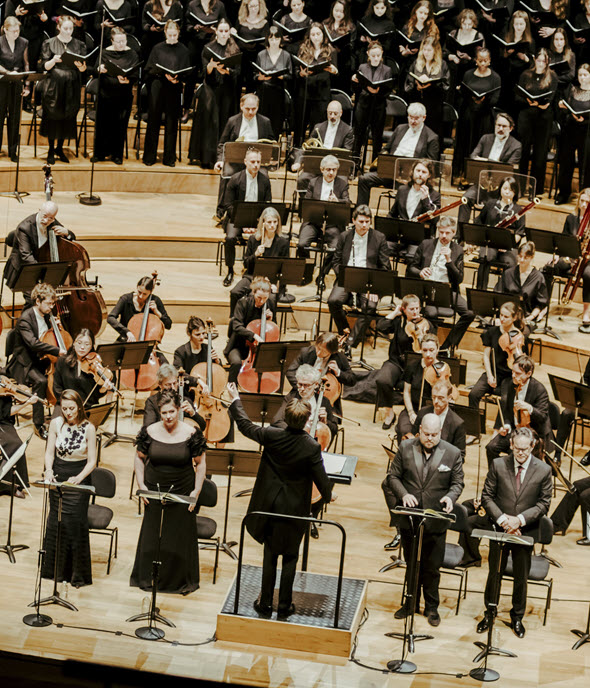
Klaus Mäkelä, music director-designate of the Chicago Symphony Orchestra, led the Orchestre de Paris in Beethoven’s Missa Solemnis. (Mathias Benguigui photo for Orchestre de Paris)
Review: Chicago Symphony music director-designate, Klaus Mäkelä conducted the Orchestre de Paris and singers in Beethoven Missa Solemnis.
By Laurence Vittes
PARIS – In just under 80 exhilarating minutes, Klaus Mäkelä led Beethoven’s Missa solemnis at the Philharmonie with the Orchestre de Paris and Chœur de l’Orchestre de Paris, revealing once again why the work remains the most formidable of choral–orchestral undertakings: spiritually uncompromising, structurally unwieldy, and stubbornly resistant to anything resembling comprehensive control.
But rather than dwelling on those challenges, Mäkelä favored momentum and cohesion over awe, unfurling the work less as an act of worship than of will. From the opening of the Kyrie, the choral sound fused into a single expressive body, the text absorbed into the broader musical arc and carried by shape and direction rather than sharply etched declamation.
The Finnish conductor, who has been music director of the Orchestre de Paris since 2021, begins his tenure as music director of the Chicago Symphony Orchestra in September 2027, at same time he assumes the title of chief conductor of Amsterdam’s Royal Concertgebouw Orchestra.
Sweet woodwinds set the tone early – Pascal Moraguès’s clarinet lines glowed throughout –- while the strings, plentiful at the high end (14 first violins alone) but lean in number on the low end (only eight cellos and seven double basses), supplied less of the warmth Beethoven must have had in mind overall and to support the basses in the chorus.

Mäkelä presided over Beethoven’s masterwork in Paris. (Denis-Allard photo, Orchestre de Paris)
Mäkelä allowed the structure to reveal itself gradually, returning to the opening material as a point of security, the woodwinds trailing off at the close with a quiet, almost magical sense of release. The Gloria arrived without ceremony, the timpani snapping into place a fraction of a second before chorus and orchestra surged ahead together. Mäkelä risked a fast tempo which the chorus met head-on, producing a magnificent, coherent wall of sound. Lyric detail occasionally yielded to propulsion, but the payoff was exhilarating.
The Qui tollis might have benefited from more organic preparation and shaping but a well-judged hush before the Miserere made its mark. When the Gloria returned, it did so with unmistakable weight: the organ asserted itself, the inner lines remained audible, the final triple meter bars were visceral, and the brass weighed in securely before the last shouted affirmation.
Speed again shaped the Credo, at first blurring the sense of the new structural plateau. Yet the exchanges that followed were sharply drawn, with telling accents in the violas and cellos and a rhythmic heartbeat that Mäkelä sustained without allowing it to dominate. Even when the Et incarnatus moved too quickly to bloom fully, the choral build-up that followed proved hypnotic, the fast sections – nearly impossibly fast – thrilled without unravelling. The final proclamations carried real ritual weight, the closing chords landing with tremendous
force.
Glorious quartet of soloists, from left: Soprano Chen Reiss, contralto Wiebke Lehmkuhl, tenor Andrew Staples, bass-baritone Gerald Finley (Matthias Benguigui photo)
Throughout the evening the four soloists, not so much stars but as a working ensemble, still could sound glorious. Soprano Chen Reiss sang with luminous focus and soaring range, Contralto Wiebke Lehmkuhl anchored the center with warmth, and tenor Andrew Staples repeatedly cut through the texture with passages of piercing intensity that brought electricity to Beethoven’s punishing tenor line. Gerald Finley remained a steady presence, his light but eloquent bass-baritone increasingly integrated into the quartet’s collective sound as the evening progressed.
In the Missa’s emotional heart, the Sanctus and Benedictus, brass sonorities amplified and resonated with the organ’s depth. The transition into the Benedictus unfolded naturally as the pulsing accompaniment cleared space for the solo violin’s entrance where concertmaster Sarah Nemtanu’s long-bowed phrasing, intimate trills, subtle portamenti, and final, heartbreaking re-entry earned her the loudest applause of the night during the post-performance curtain calls.
The Agnus Dei brought eloquence and unease into close proximity, Mäkelä shaping the opening with restraint before his shocking tempo for the martial episode. As violence flickered beneath the chorus and quartet, their optimism aligned with Beethoven’s faith held, and the final pages unfolded with deeply satisfying inevitability. The ending itself arrived abruptly, but the journey there had remained gripping and coherent.
