
Electric Berlioz experience confirmed Mäkelä as CSO’s ideal choice to bear new-era banner
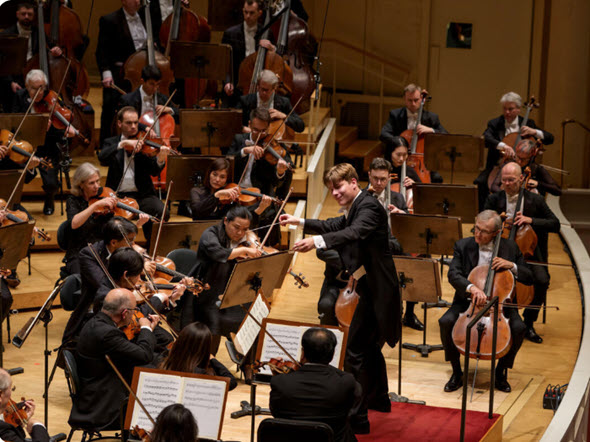
Klaus Mäkelä led an all-Berlioz program with the Chicago Symphony. (Todd Rosenberg photos)
Commentary: Klaus Mäkelä’s “Harold in Italy” and “Symphonie fantastique” stamped his coming Chicago Symphony directorship
By Lawrence B. Johnson
In the wake of Klaus Mäkelä’s resonant first appearance of the season, a spectacular all-Berlioz program Oct. 16-18, the Chicago Symphony Orchestra throttles back with a bit of chamber theater Oct. 23-25: Stravinsky’s “The Soldier’s Tale,” together with other down-sized Stravinsky pieces. Good idea, as it turns out. Everyone needs to catch their breath.
Mäkelä’s turn through Berlioz’s masterpieces “Harold in Italy,” a grand-scaled tone poem with solo viola, and the “Symphonie fantastique” was nothing short of epic. After hearing the first performance, I went back to catch the third. What I heard was unequivocal: In Mäkelä, who becomes the Chicago Symphony’s next music director in September 2027, when he will be 31, the orchestra has landed exactly the brilliant, charismatic, youthful and bold figure needed to forge the next great era at Orchestra Hall.
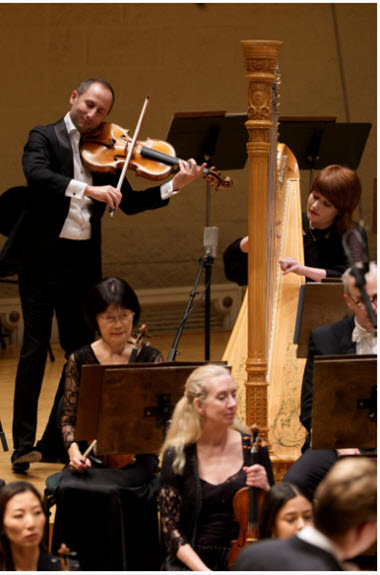
Violist Antoine Tamestit began “Harold in Italy” near the harp.
While each of the Finnish conductor’s previous visits had proved distinctive, Mäkelä’s immersive engagement with Berlioz felt different – not just musically impressive and conceptually insightful, but deeply personal, stylistically vibrant. And the orchestra responded with performances that blazed and shimmered with the full palette of Romantic color, introspection and extremity.
“Harold in Italy,” composed in 1834, or four years after the “Symphonie fantastique,” is an offbeat essay with a fascinating history almost too remarkable to be true, though it absolutely is. It was commissioned by the celebrated violin virtuoso Paganini, who had just acquired a Stradivarius viola. But when Berlioz, ever the willful iconoclast, showed Paganini what he had wrought – an orchestral evocation of Lord Byron’s melancholy wanderer Childe Harold, embodied in but not exactly starring the viola – the great violinist was roundly disappointed in the modest solo part and basically said thanks, but no thanks.
But after finally hearing a performance, on a program much like this one pairing “Harold” with the “Fantastique,” Paganini saluted the composer with both high praise and a check for 20,000 francs – which enabled Berlioz to write his dramatic symphony “Romeo and Juliet.”
Though I’ve known and loved “Harold in Italy” for 60 years or more, I’ve rarely heard it performed live. The viola part, while eloquently written, is indeed understated, with many long silences; in the raucous finale, the solo voice has all but vanished. Obviously, the silences leave the spotlighted performer simply trying to be an engaged listener. But not on this occasion.
French violist Antoine Tamestit wasn’t even on stage as Mäkelä led the CSO through Berlioz’s ruminative introduction to the opening mountain scene. And when he finally entered stage right, Tamestit turned up a short staircase to stand beside the harp. Then he struck bow to strings, two four-note phrases followed by two six-note phrases: breathtaking. In this brief, soft flourish, a thrilling violist announced himself and the musical character he would play. For it was to be a performance as meaningfully theatrical as musical.

Like Berlioz’s (and Lord Byron’s) wanderer, Tamestit meandered about the stage.
Tamestit seldom stationed himself in the conventional spot beside the conductor. He moved about the stage, from level to level, like the wanderer Harold on mountain pathways. When the finale commenced in a violent eruption, Tamestit’s daunted character shrank from his place by the podium and fled to a safer locale, behind the cellos – then, having no further music to play for quite a stretch, retreated through a rear stage door and out of sight. When the violist returned, it was as part of a delicate episode for string quartet with two members of the first violins and a cellist convened on the second level behind the harp.
The viola performance that inspired Paganini’s magnanimous gift to Berlioz must have been something like the supple, burnished display that Tamestit offered as he weaved in and out of the colorful tapestry spun by Mäkelä and the CSO. It was especially intriguing for me to witness this gentle music-drama a second time, just to see whether the reprise of Tamestit’s peregrinations would feel like schtick. It did not, but was again charming, even touching. Likewise, Mäkelä’s sensitive connection to the score and the orchestra’s lustrous, vibrant playing shone brightly on both nights.

Antoine Tamestit and Klaus Mäkelä shared a thunderous ovation after “Harold in Italy.”
The conductor, who seemed to turn score pages almost absently in his detailed traversal of “Harold,” eschewed a score altogether for the “Symphonie fantastique.” Subtitled “Episode in the life of an artist,” this opium-induced dream-trip in five movements is more of an all-around virtuosic challenge for an orchestra than its ubiquitous appearance on concert programs might suggest. From the first stirring of “daydreams and passions” through the grand swirl of a ball and the languorous interlude of a pastoral scene, Mäkelä shaped a luxurious, mesmerizing account.
But where this young conductor really showed his prodigious maturity was in the elegance and precision he brought to the fearsome “March to the Scaffold” and the finale’s mad ‘Dream of a Witches’ Sabbath.” Even delivered in broad strokes, both of those clamorous movements can make quite an impact. But Mäkelä and the closely disciplined CSO went far beyond the obvious to reveal the animating subtleties of Berlioz’s finely wrought constructs. They took a magnificent symphony to an exhilarating new place.
When Mäkelä returns Dec. 18-20 for the second his four CSO programs this season, he will give Chicago its first glimpse of his Beethoven with the Seventh Symphony. Van Cliburn Competition winner Yunchan Lim, who packed Orchestra Hall for his splendorous account of Bach’s “Goldberg” Variations on Oct. 19, will be Mäkelä’s soloist for Schumann’s Piano Concerto in A minor. There may be seating needed in the lobbies and corridors for that weekend.
