
More than a year out from CSO directorship, Mäkelä has already put his brand on the band
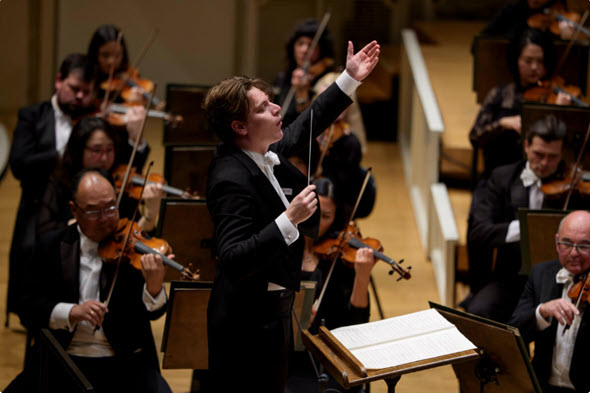
Finnish conductor Klaus Mäkelä, the Chicago Symphony’s music director-designate, led a performance of “The Rite of Spring” at Orchestra Hall. (Todd Rosenberg photos)
Commentary: In concerts at Orchestra Hall and a tour, Klaus Mäkelä and the Chicago Symphony pointed toward a golden era.
By Lawrence B. Johnson
The Chicago Symphony Orchestra and Klaus Mäkelä are ahead of the timeline in the runup to his formal investiture as music director in September 2027. In any meaningful sense, the orchestra is now Mäkelä’s, a reality that was on full display in the young Finnish conductor’s consecutive concert programs Feb.19-21 and March 5-6 at Orchestra Hall – and in his Eastern U.S. tour with the band during the interval between those weekends on home ground.
In January 2027, many months before the qualifier “designate” is dropped from the title music director, Mäkelä will lead the CSO on a banner two-week trek across Europe. The sea change has happened, and for both the musicians onstage and the audiences who flock to Orchestra Hall, this is a charged turning point, the auspicious onset of a new chapter. Mäkelä’s recent Chicago concerts were Events. I attended four of the five evenings, and each night his arrival on stage brought a stormy ovation, and each night’s performance brought down the house.

Mäkelä offered CSO audiences a rare opportunity to hear a complete performance of Sibelius’ epic tone poem “Lemminkäinen.”
At age 30, Mäkelä’s musical command already embraces a broad repertoire tellingly sampled in his latest weeks with the CSO – from Richard Strauss and Sibelius to Milhaud, Gershwin and Stravinsky. Indeed, the run ended with Stravinsky’s brilliant, still radical, still daunting ballet “The Rite of Spring,” in performances that progressed from superb the first night to electrifying the next. One could argue that “The Rite of Spring,” with its relentless rhythmic complexity, brash harmonic clashes and episodes of disarming lyric beauty, provided a summing up of Mäkelä’s technical and expressive mastery. After that second performance, the standing audience whooped and cheered until the conductor waved goodnight.
Even 113 years after its premiere on a night of legendary tumult in Paris, “The Rite of Spring” remains an imposing challenge for any orchestra. It calls for an outsized force of instruments that must execute hair-raising ensemble pyrotechics – close-order drills at high speeds amid constantly offset and irregular rhythms. But Stravinsky’s writing is also gorgeous, subtle, profoundly expressive. At its most ferocious, “The Right of Spring” can be downright scary. Makela’s take on it was fierce, fast, furious, but also eloquent, languorous, magically evocative of Stravinsky’s earlier ballet “The Firebird.” And the Chicago Symphony, locked in, unleashed performances of astonishing virtuosity, whether blazing at full tilt or summoning a gauzy mysticism.
The whole concert program bore a Parisian stamp, starting with Darius Milhaud’s jazzy, funky, noisy, swinging showpiece “Le boeuf sur le toit” (The Ox on the Roof). Mäkelä and company gave this 1920 caper a brash go, setting up Gershwin’s timeless portrait “An American in Paris.” Here, too, the conductor captured the music’s essential vibrancy, its energy and panache as he melded red, white and blue into bluesy-blanc-rouge.

English horn Scott Hostetler made eloquent work of his featured part in “The Swan of Tuonela.”
Highlighting the orchestra’s eastern trek the previous week was its first appearance with Mäkelä at Carnegie Hall in New York, where the CSO reprised an Orchestra Hall program of Sibelius’ symphonic poem in four episodes, “Lemminkäinen,” and Strauss’ splendorous symphonic poem “Ein Heldenleben.” Just as I managed to catch “The Rite of Spring” twice, I also heard two nights of the Sibelius-Strauss bill, a clear indicator of the rapport that has developed between a formidable orchestra and its all-devouring new music director.
American concert audiences rarely get the chance to hear a complete performance of “Lemminkäinen,” though most listeners would recognize its second movement, “The Swan of Tuonela.” The work’s title refers to a hero-adventurer not unlike Wagner’s Siegfried, though Lemminkäinen strides through Finland’s national epic “The Kalevala.” In the suite’s second chapter, a still-voiced adagio largely sung by English horn, Sibelius portrays the graceful swan of the land of the dead, Tuonela. The third part is a masterful, detailed tone painting of Lemminkäinen’s disastrous visit to Tuonela, and the galloping finale evokes the patched-together hero’s journey home.

Concertmaster Robert Chen’s ravishing solo playing was a highlight of Strauss’ “Ein Heldenleben.”
Mäkelä, whose native immersion in Sibelius includes a recording of the complete symphonies with the Oslo Philharmonic, elaborated the canvas of “Lemminkäinen” with a fine-tipped brush. English horn player Scott Hostetler’s shadowy, sensuous limning of the swan of Tuonela was the performance highlight, which is to take nothing from a collective orchestra effort that captured the entire work’s grandeur, Technicolor splendor and interior inflection.
In Strauss’s “Ein Heldenleben,” which portrays everyman – or perhaps every artist – as hero, Mäkelä conjured a knowing, nuanced account that elicited a bravura effort from the CSO. The solo star this time was concertmaster Robert Chen, whose ravishing violin sound drew the grander sonorities down to a filament of finesse. The audience obviously knew what it was hearing in this music’s familiar sweep, and responded with ripping approval. To be sure, the new music director (designate) has been keenly embraced by the ticket-holders. But buckle up, Klaus Mäkelä hasn’t even (officially) begun.
