
Amid familiar brilliance of Muti CSO concerts, Brahms (on bizarre night) got lost in shadows
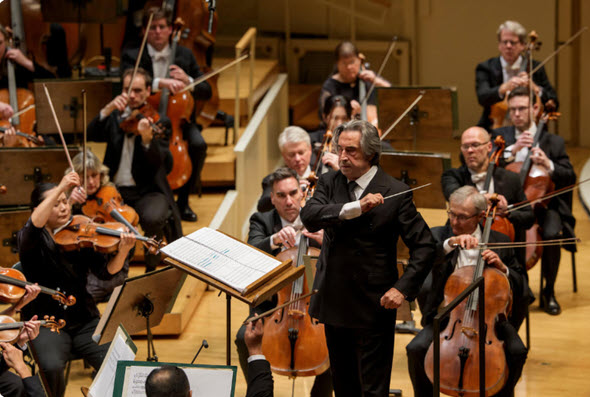
Riccardo Muti, the Chicago Symphony Orchestra’s music director laureate for life, led two weeks of concerts at Orchestra Hall. (Todd Rosenberg photos)
Commentary: Riccardo Muti’s recent two-week visit with the Chicago Symphony was a roller-coaster run: dazzling, curious, off the rails.
By Lawrence B. Johnson
A singular linearity has defined Riccardo Muti’s many seasons and concerts with the Chicago Symphony Orchestra: What you expect – the conductor’s distinctive sensibility coupled with a supreme level of musical performance answered by ripping ovations – is what you get. But Muti’s recent two-week stint with the CSO shattered the rule. By turns brilliant and humdrum and just bizarre, these concerts swung from exhilarating highs to curious lows, all of it mirrored in audience responses of familiar acclaim and mere politesse.
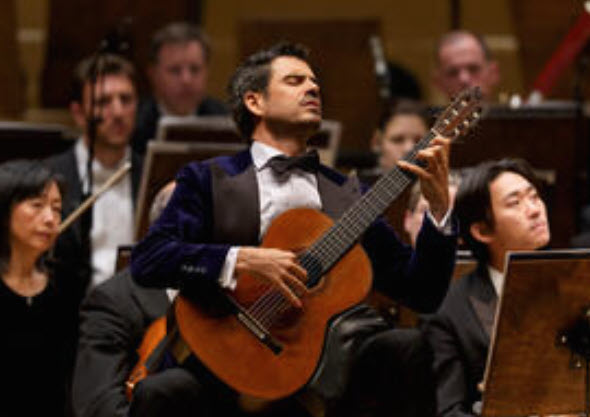
Guitarist Pablo Sáinz-Villegas was electrifying in Joaquin Rodrigo’s “Concierto de Aranjuez.”
The most extreme swing came in concerts Nov. 6 and 7, during the second of Muti’s two weekends, when Brahms’ Symphony No. 4 in E minor capped a program that began with the divertimento Stravinsky fashioned from his ballet “The Fairy’s Kiss” and progressed to Joaquin Rodrigo’s enduringly popular “Concierto de Aranjuez” for guitar and orchestra. The concerto played by guitarist Pablo Sáinz-Villegas, and the prodigious encore that followed, produced a sensational effect on opening night that had the giddy audience chattering about it through intermission to the very moment the orchestra retook the stage to play Brahms.
It wasn’t only Sáinz-Villegas’ elegant and impassioned, precise and rhapsodic playing that took one’s breath away; he was matched by Muti’s keenly attuned, marvelously poetic conducting and an orchestral performance that seemed to capture every nuance and inflection of Rodrigo’s finely crafted score. The ovation was tremendous. Sáinz-Villegas was called back to the stage three times – and when it seemed he might not accommodate the clamorous house with another little something, the commands rang out: “Encore! Encore!”
And so the 48-year-old Spanish-born guitarist, by now a longtime resident of the U.S., seated himself to reminisce about growing up in La Rioja, wine country in north-central Spain, and how he used to dance with his neighbors to this music he was about to play – a jota by the Spanish composer of many marvelous guitar works, Francisco Tarrega. Then off he flew on a virtuosic amalgam of ballade and scherzo, buoyant dance and heady march as drum riffs flashed from the strings. The crowd went wild.
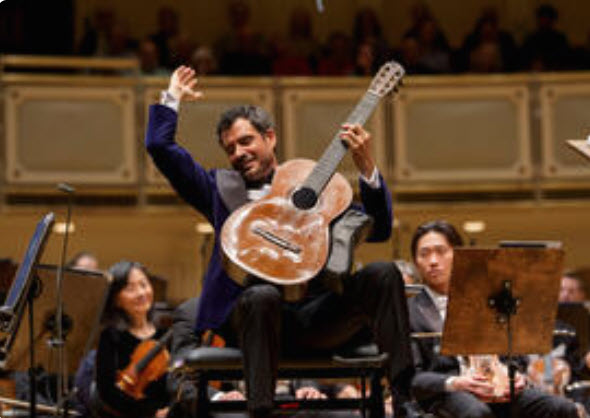
Sáinz -Villegas’ spellbinding encore, a jota by Francisco Tarrega, brought down the house.
Breathtaking? When Muti struck up the Brahms Fourth, it felt as if the breath, the air, had been sucked from the hall. The Brahms never took flight. It felt perfunctory. It surely did not engage a house packed as always for a Muti concert. The applause was muted, polite, seated – notably less than when Muti had first walked onstage, before a note had sounded.
The experience was so strange, the pedestrian effort so unlike the Chicago Symphony and this maestro who holds the rank of conductor laureate for life, that I decided to go back the next afternoon. That reprise brought the Brahms Fourth one would expect from the band and the man: majestic, expansive, its energy smartly gauged from the lyrical ease of the opening movement through the subtly inflected variations of the crowning passacaglia. The audience heard it, too, this time whooping and cheering – and standing.
Meanwhile, the Rodrigo concerto was again splendid, if not quite the scintillating, hair-raising thriller of the previous night. Nor did Sainz-Villegas repeat that astounding jota, but rather offered different encore by Tarrega, the luminous “Recuerdos de la Alhambra.” This time, there would be air enough left for Brahms.
Muti’s opening week with the CSO (Oct. 30-Nov. 1) was a bit odd in its own fashion. The centerpiece, Dvorak’s Symphony No. 9 in E minor (“From the New World”), offered an eloquent reminder of how generously the CSO was nourished under Muti’s long directorship. Here was epic story-telling – songs from the earth, if you like. In any case, Dvorak’s robust and lyrical symphony resonates of his Bohemian homeland, and Muti captured its exuberance and its wistfulness with equal empathy and assurance. The ruminative slow movement’s famous theme was infused with tender reflection by the CSO’s stellar English horn Scott Hostetler.
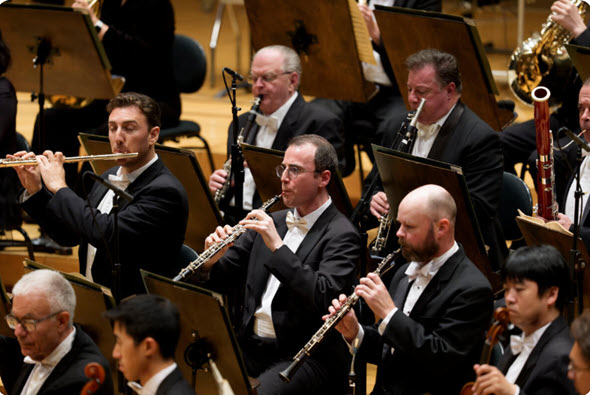
The CSO winds shone everywhere during Muti’s two programs at Orchestra Hall.
The oddity for me was the choice of Hindemith’s Symphony “Mathis der Maler” – or Mathis the Painter, a three-movement suite of music from his opera about the 16th-century German Renaissance artist Matthias Grünewald. The work, which has always enjoyed high esteem among musicians and scholars, has always struck me as music that’s probably more rewarding to play than to hear. Its three episodes are unwaveringly severe, detached, charmless and correct.
I am holding a petition for shelving “Mathis der Maler” signed by the muted applause of the CSO audience. What was assuredly a disciplined performance elicited a good-faith response. Dvorak’s symphony was still to come, and the ovation for that red-blooded music would make the rafters ring.
One final note: Muti opened this program with Johann Strauss Jr.’s Overture to “The Gypsy Baron.” No doubt Muti, who frequently has led the Vienna Philharmonic in its New Year’s concerts, tried to instill the Viennese native flair into the CSO, as it were to give a name to something in the blood, to label the ineffable. The result was one great orchestra channeling another, on not quite even terms.
